 RuvidaMente

















































Citric fruit has grown widely in Mediterranean countries since ancient times, but until the Arab conquest of southern Italy its use was purely ornamental or restricted
to religious ceremonies. With the arrival of the Arabs, the eating of oranges became common practice among the people. The IGP (Protected Geographical Designation) certification for the
Arancia Rossa di Sicilia is restricted to the Tarocco, Moro and Sanguinello varieties of the fruit.
The chief features of these varieties are their intense internal colouring (brought about by the anthocyanin pigments in the endocarp) their attractive external colour
and lovely sweet taste. The Arancia Rossa di Sicilia exemplifies how local climatic factors have a direct bearing on the essential properties of a crop. Oranges of the very same variety
grown in other climates do not have the same striking colour nor the organoleptic qualities that have made the Sicilian orange famous throughout the world.
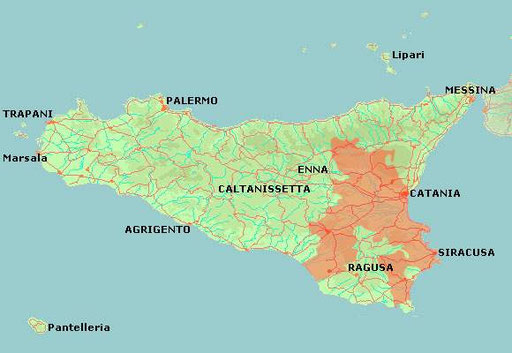
The Arancia Rossa di Sicilia is effectively a mutation caused by local pedological and climatic factors. The areas of cultivation are located in numerous town
districts in the provinces of Catania, Ragusa, Syracuse and Enna.






SEARCH THE SITE
