 RuvidaMente




































Historical documents indicate that the cultivation of olives in the territory of Bari (Terra di Bari) dates back to the Neolithic era (5,000 BC) and was the
main agricultural activity at the time. In later ages, olive oil acquired an economic and commercial importance, and under the Roman Empire, its export was controlled by central government. In
the Middle Ages, the cultivation of the plant was further encouraged by religious orders. Olive oil from the territory of Bari was popular in Venice from where it was exported further afield to
other European cities.
Olio Extravergine d'Oliva Terra di Bari has an acidity of 0.60 percent. Its colour ranges from green to yellow. The taste is fruity with tones of grass and
fresh almonds with a slight bitter and peppery aftertaste. The olive tree is a natural feature in the province of Bari, not only in the sense that it is a species of plant that prospers in the
natural habitat of the zone, but also because it is an essential part of the local landscape and an integral part of the history, culture, tradition and commerce of Puglia.
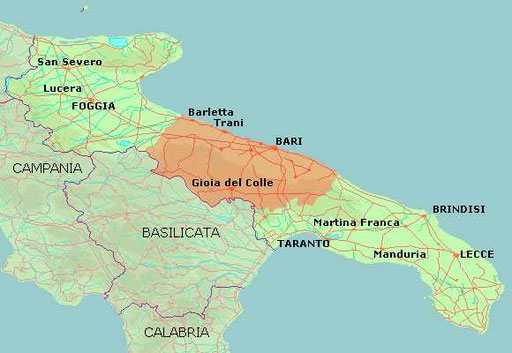
The designated Terra di Bari production zone encompasses all the administrative districts within the province of Bari. There are three sub-designations
corresponding to three distinct areas of production: Castel del Monte, Bitonto, and Murgia dei Trulli e delle Grotte. Each of these areas produces its own particular variation
of Olio Extravergine d'Oliva Terra di Bari.






SEARCH THE SITE
