 RuvidaMente
















































Bergamot is the fruit of Citrus Bergamia, a small, evergreen tree of the rue family. It is a beautiful yellow-color, pear-shaped fruit weighing an average of
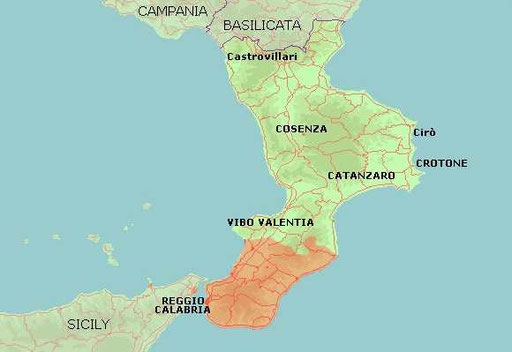
3.5 ounces. Bergamots are cultivated only in a narrow strip of the Calabrian coastland extending for about 60 miles from Villa San Giovanni to Gioiosa Jonica, between the Tyrrhenian and the
Ionian Seas, in the province of Reggio Calabria.
The origins of Bergamot remain obscure; it is thought that it might be the result of the mutation of another citrus species. Legend has it that bergamot was imported
into Europe from the Canary Islands, where it had been introduced by Christopher Columbus. Whatever its origins, this strip of coastland in Calabria is the only place in the world where bergamot
meets its optimal conditions for fructification.
The first bergamot grove was planted in 1750 by a certain Nicola Parisi in his Giunchi estate near Reggio Calabria. Back then the essence of the fruit was extracted
manually by pressing the rind onto natural sponge placed over special containers.
Nowadays, extraction takes place through abrasion. In 1844 the first industrial methods were employed in the extraction of bergamot essence. The machine used in this
process was called "Macchina Calabrese." This machine, invented by Nicola Barillà, reduced the amount of time required to extract the essence while increasing both its quantity and
quality.






SEARCH THE SITE
