 RuvidaMente


















































Although even to the majority of Italians bottarga has revealed itself only in recent years, the most refined gastronomes have appreciated it for centuries, led by
Bartolomeo Scappi, personal cook of Pope Pius V, who in his writings dwells on the superior quality of mullet and sea bass.
One of the best of all is the one produced in August and September by the fishermen of the pond of Cabras, in the province of Oristano, where mullet abounds and the
ovarian sacs can be processed at the same time as fishing.
After being carefully extracted, so that they do not tear, they are salted and drained on an inclined plane, exerting a slight pressure so that they lose most of their
vegetation liquid. Once this operation is complete, they are left to air dry for a few days and then left to mature for 60-90 days in a dry and ventilated place.
At the time of purchase, the mullet roe must be uniform in colour tending to brown, without spots and mottling, firm and compact when cut, with the membrane of the
ovarian sac well adhered to the dried mass of the eggs.
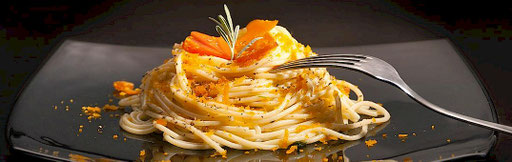
The easiest way to use tuna bottarga is to combine it with pasta sauce: grated it can be sprinkled on appetizers, croutons, savory pies and pizzas. You can
arrange the tuna roe, thinly sliced, on a plate and enjoy it plain with oil and lemon juice.
Mullet bottarga is mainly eaten raw, cut into thin slices and seasoned with oil and lemon, or grated on pasta, risottos and other dishes. It is also
excellent on toasted bread croutons.
For both types it is good to use the precaution not to cook it, except to heat it slightly if grated.





SEARCH THE SITE
