 RuvidaMente



















































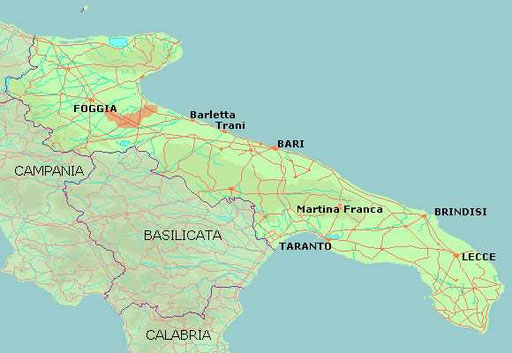
Bella della Daunia table olives grow in a zone that extends northwestward from Trinitapoli, a few miles from the Adriatic, and arcs along low foothills that
serve as advance sentinels of the Mountains of the Daunia. The mountains separate northern Apulia from Campania and Daunia is the ancient name of the territory. The production zone of the olives
is situated entirely in the province of Foggia.
Cultivation, annual pruning, training system and planting density must all accord with the tradition of the production zone and the maximum number of trees an acre is
fixed at 170. The olives must be picked directly from the tree around which cloths can be spread to prevent the drupes from touching the ground. The green olives must be harvested between October
1 and November 20 or when the skin begins to turn from leaf green to straw yellow/green.
The black olives must be gathered between October 25 and December 10, when they develop a wine-red color. Irrigation must cease 10 to 15 days before the harvest.
Maximum permitted production per acre is 4.9 tons. The green olives are sorted according to size and immersed in sodium hydroxide until the solution has penetrated about two-thirds of the
thickness of the fruit. This phase lasts eight to 12 hours. Afterward, the drupes are washed carefully with water and then covered with brine. After fermentation, the olives are packed in brine
in glass or metal containers. Pasteurization or sterilization completes the process.
The black olives are sorted and immersed in brine to await processing. Afterward, the olives are placed in sodium hydroxide. The solution is repeatedly changed until it
penetrates to the pit. If necessary, the olives are treated with iron gluconate or alimentary ferrous lactate to turn them completely black. They are then washed, steamed and
packaged.
The green La Bella della Daunia table olive must have a uniform straw-yellow/green color. It is elongated in shape, resembling a Damson plum. The skin is thin
but the pulp is firm, almost crunchy. When released onto the market, the black olives must have the following characteristics: an intensely black color, an elongated, plum-shaped drupe and a thin
skin, while the flavor is full and delicate.






SEARCH THE SITE
