 RuvidaMente
































DRY PASTA
For centuries, dried pasta has been an important, even a vital, element of the Italian diet. Pasta, dried or fresh, is a relatively simple food product but it is highly
nutritious, enormously adaptable and blessed with a long shelf life-a year and much more if stored in proper conditions. Many arguments have raged around the origins of pasta but conclusive proof
for any of the many theories is still lacking. It is clear, however, that it is an ancient food product and that the Italians have done more than virtually any other people to develop its
potential.
Dried pasta is usually produced from hard or durum wheat, which offers pronounced resistance to the effects of drying and cooking. Dried pasta has always been
associated with southern Italy, although it is as common in the north or virtually every part of the world. Naples was particularly noted as a processor (and consumer).
Old prints and drawings show workshops where miles of spaghetti were strewn over racks to dry in the hot Mediterranean summer. Pasta-macaroni to southerners-was cooked
the city's streets and piazzas and served, along with the ubiquitous tomato sauce (but only after that food was brought from the New World in the 16th century) and grated cheese. Consumers would
take the pasta, usually spaghetti, with their fingers and dangle it into their mouths, returning the bowl to the vender when it was empty. The princesses of the royal court of Naples once
scandalized a guest by employing the same technique at the table.
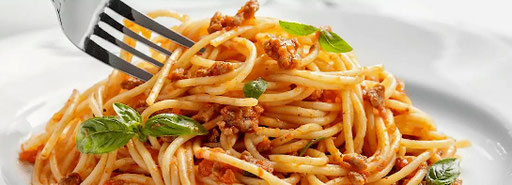
Modern producers use processes that are much more sophisticated than drying pasta in the open air. The dough is extruded under pressure through holes of varying size
and number in a metal (sometimes plastic-coated) plate and then quickly dried in large ovens in which temperatures and humidity levels are carefully controlled. The result, usually, is small
tubes; that is, the pasta is perforated.
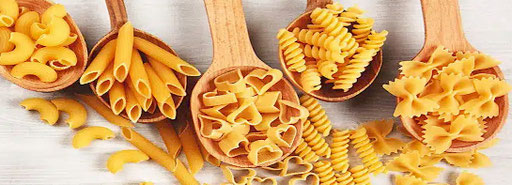
The diameters of these tubes can be large, small or tiny and their lengths are just as varied. Some have ridged surfaces and some are smooth. Some are bent, like
elbows, and others are straight. The different sizes and shapes are important not only because they assure variety, that spice of life, but also because they will determine within limits the way
in which the pasta will be cooked and especially the type of sauce or garnish with which it will be flavored.
Hard wheat is also used in southern Italy to produce some non-tubular pastas, like Apulia's orecchiette, which is shaped like a small ear, or
cavatieddi (small shells). Both are usually prepared with vegetable garnishes, including turnip tops, potatoes and rue, sweet peppers or green cauliflower among others. Although still
widely made at home in Apulia, these pastas are also available dried on markets throughout Italy and abroad.
MORE ON DRY PASTA SHAPES
● Anellini ● Bavette/Trenette/Linguine ●
● Bucatini ● Capellini ● Conchiglie rigate ●
EGG AND FRESH PASTA
As the name indicates, egg pasta is pasta to which eggs (or egg yolks) have been added. The eggs provide a bit of additional flavor but they are there primarily because
they help bind the dough and keep it from disintegrating during cooking. The eggs and particularly the yolks also give the pasta a rich yellow color that adds to this food product's appeal. Eggs
are normally used in the production of fresh pastas, while they were less commonly (or traditionally) included in dried versions.
Durum wheat is customarily employed in the production of dried pastas and it holds up extremely well to the stress of drying and cooking.
Pastas to which eggs are added were customarily fresh but today they are just as likely to be dried. In any case, egg pastas can be cooked, sauced and presented in
virtually all the ways fresh or dried versions are served.

Northern Italy was and to a certain extent remains the homeland of fresh pastas. These pastas are traditionally made with wheat that is somewhat softer than durum. They
are not usually extruded but rolled out and then cut to the desired shape. They are often formed into envelopes or cylinders and then stuffed and sauced. In the past, fresh pasta was made at
home, in restaurant kitchens or in small shops in cities and towns of sufficient size.
Most housewives prided themselves on their skill in turning out perfect pasta and many still prepare it regularly or at least on special occasions. Because of the
development of vacuum packaging, fresh pasta is readily available in gourmet shops as well as many regular retail stores and even supermarkets not only in Italy but also in many countries
throughout the world. The selection of vacuum-sealed fresh preparations includes many prepared dishes in which the pasta has been stuffed and sauced. All that is required is brief baking in the
oven (or boiling if the pasta is only stuffed and sealed but not sauced). A sprinkling of grated cheese (plus basting with butter, oil or sauce, if the stuffed pasta is boiled) and the dish is
ready to serve.
Fresh pasta is normally made with semolina (middlings), eggs and salt. In the Po Valley (and now elsewhere), puréed spinach is occasionally added to give the pasta a
special flavor and color. Less common are pastas in which tomato concentrate or sauce, puréed mushrooms and other ingredients have been added. Noodles (fettuccine, tagliatelle,
tagliolini and tajarin as well as many other terms) are the most common form of fresh pasta. Length and width vary but all are thin.

Stuffed pastas have an ancient tradition, perhaps beginning with ravioli (agnolotti in Piedmont and Rome), which are stuffed with just about everything under
the sun-it all depends upon regional or local tradition or the whims of modern cooks. In shape, ravioli are round, square or half-moon disks. Tortellini, served with butter and cheese or
in broth, and tortelloni, which are primarily larger versions of the first, are savored in Bologna and, now, everywhere. Tortelli are similar to ravioli and the most famous is the
version associated with Mantua in which pumpkin is the principal ingredient of the stuffing. Cannelloni are pasta tubes with varied stuffings and sauces now served throughout the
country.
Fresh pastas are also made with rye flour in Alto Adige on the border with Austria and buckwheat (grano saraceno) in the Valtellina in northern Lombardy. Variations on
flat, thin fresh pastas include maccheroni alla chitarra and bigoli. The chitarra is a frame with metal strings stretching its length. The sheet of dough, often of
durum, is placed atop the strings and pressed down with a rolling pin. The result is not tubular like macaroni. Bigoli are thick spaghetti made in the Veneto by forcing whole-wheat dough
through a small press (bigolaro).
MORE ON FRESH PASTA SHAPES
● Cannelloni ● Crespelle ●
● Fettuccine ● Lasagne ● Pappardelle ●
● Pizzoccheri ● Ravioli ●
● Taglierini ● Tagliolini ● Tortelli ● Tortellini ●








SEARCH THE SITE
