 RuvidaMente






































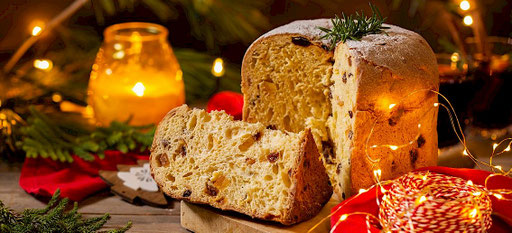
PANETTONE
Panettone appeared in northern Italy around the 15th century. It probably originated in Milan, since this naturally leavened bread has always been closely
associated with the city, the capital of Lombardy. However, somewhat similar although less sophisticated breads have been made throughout Italy since at least the days of imperial
Rome.
Most probably professional bakers developed Panettone and were largely or entirely responsible for its production from the beginning, since the process
involved is highly complex and requires facilities and equipment that the home kitchen usually lacked in the past. It is doubtful that this famous specialty bread appeared on the scene in a form
familiar to comsumers throughout the world today. It evolved over the centuries as new techniques were adopted and the quality of the raw materials used in its preparation improved.
The custom of consuming Panettone, especially during the year-end holiday season, spread from Milan throughout Italy, from the Alps in the north to Sicily in
the south. As the bread's popularity grew, people began to speculate about its origin. As a result, Panettone spawned many legends.
The most popular concerns a young Milanese nobleman, a member of the Atellini family, who fell in love with the daughter of a baker named Toni. To impress the girl's
father, the young man disguised himself as a baker's boy and invented a sweet, wonderful bread of rare delicacy and unusual size with a top shaped like a church dome.
This new, fruitcake-like bread enjoyed enormous success, with people coming to the bakery in droves at all hours to purchase the magnificent Pan de Toni (or Tony's Bread).
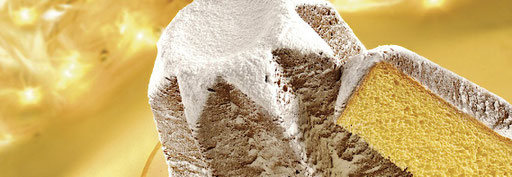
PANDORO
Second only to the Panettone in holiday popularity and also very well known abroad, Pandoro (golden bread) is of more recent origin and therefore,
more reflective of today's tastes. Emerging in Verona a century ago when changes in fashion favored lighter leavened doughs over heavy, almondy pastes, Pandoro adheres closely to a
production formula in the Venetian tradition. Tall, distinctive and shaped like a Christmas tree, it is topped with powdered sugar reminiscent of snow, or a twinkling star. And indeed, if cut
horizontally, each slice is a star.
Like Panettone, Pandoro may be enjoyed plain; but also, it is presented traditionally at restaurants and private parties with many types of creams or
sauces, such as mascarpone, champagne, melted chocolate or whipped cream poured over its slices. At times, the top may be hollowed and stuffed to overflowing with ice cream, zabaglione or other
tasty fillings.
Taking note of this homemade enrichment, the Italian confectionery industry has adopted some of these excellent variations of the traditional recipes, so that today it
is easy to find chocolate covered, chocolate filled, chocolate chipped or ice-cream filled Pandoro, as well as similarly enriched Panettone, at the local supermarket or gourmet
shop. Pandoro, the "Golden Bread," is a delicacy to make any moment golden.




SEARCH THE SITE
