 RuvidaMente














































As Europe's leading rice producer, Italy specializes in varieties of short, ovular grains bred expressly for the extended braising of risotto. Most of the world's rice
is the long-grain type suited to boiling or steaming.
Rice is grown in much of the Po valley, though the prime risaie lie in Lombardy's Lomellina area and in Piedmont around Vercelli and Novara.
Italian rice is grouped in four categories according to size and cooking time, ranging from the small comune or originario to semifino, fino, and superfino.
Superfino, due to its tenacity, is suited to classical risotto, though cooking performances vary among a dozen types. Arborio is popular, though chefs often prefer
Carnaroli, Baldo or the semifino Vialone Nano. Riso Vialone Nano Veronese is IGP.

The Vialone Nano variety of rice was first created by the Vercelli Rice Experimental Station. The rice began to be cultivated in 1937 and was introduced to the province of Verona in
1945. Of the more than 24 varieties of rice grown in Italy, Vialone Nano is chronologically the second oldest after Balilla. The soils around Verona proved to be particularly
well suited for Vialone Nano which became ever more widespread and is now the chosen variety for ninety per cent of paddy fields in the region.
The IGP certification for Riso Vialone Nano Veronese refers exclusively to rice obtained from seeds carefully selected from the Japonica strain of the
Vialone Nano variety. The rice comes into season slightly early, the plant is medium-tall and the rice grains are fine, muticous and pearly. Although the processing of the rice is
carried out using highly advanced technological means, the procedures remain essentially simple and straightforward, and the final product that is sold to the consumer has not undergone any
chemical treatment or other form of manipulation.
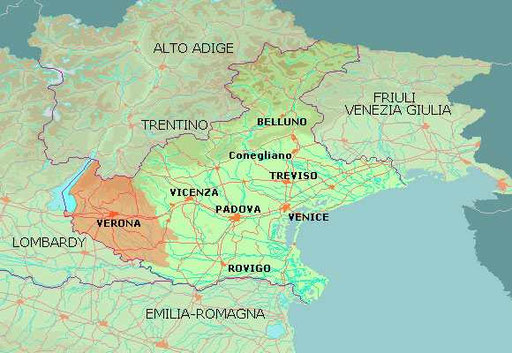
The rice may be cultivated only within the delimited area which enjoys a uniform climate conducive to growth. The zone is also supplied with plentiful springs of pure
sweet water. This hydrological feature allows the practice of crop rotation which considerably reduces both the need for and use of chemical fertilisers. The area of production includes numerous
town districts in the province of Verona.






SEARCH THE SITE
