 RuvidaMente





































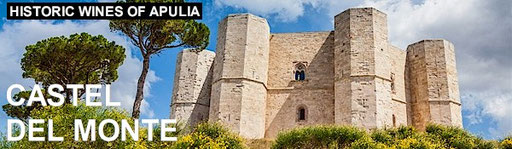
The wine is named for an imposing castle in pure Gothic style that is situated in the vicinity of Andria on the slopes of the Murge Mountains. Emperor Frederick II had
the fortress built on a high hill according to plans that he himself had drawn up. The result was highly unusual. The structure of the castle is in the form of an octagon, with a tower at each
exterior angle. The towers are also octagons. Inside, there are eight trapezoidal halls on two levels surrounding the octagonal courtyard.
Frederick II’s plan has been explained in various ways. The most widely held opinion is that the castle was intended as the emblem of an esoteric astrological ideology
in which science, the lay state and empire are emphasized. The octagon form was associated with the zodiacal course of the sun. The crown, which is what the castle, seen from a certain distance,
resembles, signified power. And the well of the courtyard with its high walls was the image of science.
The vineyards surrounding the Castel del Monte are found at altitudes of 300 meters and above, where climatic conditions are particularly favorable to the cultivation
of grapes.
Castel del Monte wine is produced in three versions—red, white and rosé.
The red is derived primarily from the Uva di Troia variety, which is also known as the Uva della Marina, since it has been grown with great success in
the fields of some communes along the coast to the north of Bari. The variety’s official name is that of a small town in the province of Foggia and it is used in the grape mixtures of the
principal Denominazione di Origine Controllata wines of the Bari and Foggia districts.
The white version is obtained from the Pampanuto variety, known also as Pampanino. Its cultivation is limited to the Corato and Ruvo zones. Until the
last century, it was also known as Pampanuto di Terlizzi, since it was extensively grown in the vicinity of that small community in Bari province.
The Castel del Monte Rosato is made principally from the Bombino Nero variety, whose clusters of medium size have a rather unusual pyramidal form that
is thought to resemble a child (bambino) with its arms outstretched. Bombino is simply a variation of bambino.
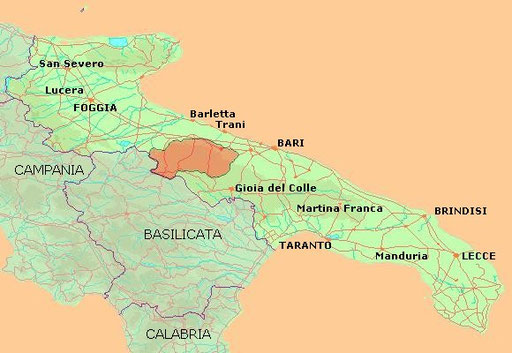
Map of the production area
GO TO SOUTH REGIONAL WINES

OR MOVE TO THE OTHER MACRO-AREAS




SEARCH THE SITE
