 RuvidaMente













































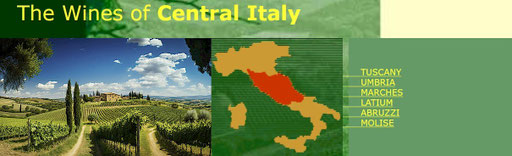
RENAISSANCE IN THE HEARTHLAND
The historical hills at the heart of the peninsula, favored by ample sunshine and moderate temperatures, boast extensive natural conditions for fine wine. In the past,
winemaking methods were often rustic. The practices of overproducing grapes and undervaluing scientific techniques sometimes squandered the excellent potential. But today the central regions, led
by Tuscany with Chianti Classico, Brunello di Montalcino and other noble reds, have moved to the forefront of Italian winemaking.
Between them, the six regions produce about 20 percent of the nation's wine and account for about 20 percent of the DOC or DOCG. The conflict between
progress and tradition persists in places, but overall the renaissance in Italian wine has generated unrivaled momentum in the heartland. Still, there is no doubt that even greater things lie
ahead.
The regions of central Italy are divided physically, and to some degree culturally, by the Apennines. To the west, on the Tyrrhenian side, lie Tuscany, Latium and
landlocked Umbria. To the east, on the Adriatic side, lie Marches, Abruzzi and Molise. Viticulture on the Tyrrhenian side is dominated by the dark-skinned Sangiovese (whose various
clones include some of Italy's noblest grapes for red wine) and the light-skinned Trebbiano and Malvasia (designed chiefly for quantities of tasty if rarely inspiring whites).
The realm of Sangiovese is Florence's region of Tuscany, where it prevails in Chianti, the nation's archetypal red, as well as in Brunello di
Montalcino, Vino Nobile di Montepulciano and most of the noteworthy classified and many of the unclassified reds known as
“Super Tuscans".

White Malvasia reigns in Rome's regionof Latium. It is prominent in Frascati and the wines of the Alban hills, and combines with the ubiquitous
Trebbiano in Est! Est!! Est!!! di Montefiascone and most other whites of the region.
Umbrians have had the chance to pick and choose, favoring Sangiovese for their reds and the Procanico strain of Trebbiano for their prominent white
Orvieto.
A trend, more evident in Tuscany than elsewhere, is to introduce noble outsiders, Cabernet Sauvignon, Merlot, the Pinots, Chardonnay and
Sauvignon. But efforts are also being directed at upgrading such worthy natives as Vernaccia di San Gimignano,
Umbria's Sagrantino and Grechetto and Latium's Cesanese.
The Adriatic regions have a rather neat and straight-forward structure of vines and wines. Vineyards are almost all planted in hills running in a tortuous strip between
the sea and the mountains, where the climate is tempered by cool air currents.
Two native varieties stand out along the Adriatic coast, the white Verdicchio in the Marches
and the red Montepulciano, which originated in the Abruzzi and is now widely planted elsewhere, including in Molise. The
influences of Tuscany and Romagna can be tasted in Sangiovese (especially in the Marches) and Trebbiano (planted nearly everywhere that worthier varieties are not).
Montepulciano can be remarkable on its own, though it also has a natural affinity for blends with Sangiovese in such fine reds as the Marches' Rosso Piceno and Rosso Conero.
GO TO CENTRAL ITALY REGIONAL WINES

OR MOVE TO THE OTHER MACRO-AREAS







SEARCH THE SITE
