 RuvidaMente































In a country like Italy, which has been producing wines for about 3,500 years, a Brunello di Montalcino can be considered a modern invention. It is not, in
fact, a wine made in homage to local traditions but the result of the studies of a single winemaker, Ferruccio Biondi-Santi.
Around 1870, Ferruccio Biondi-Santi began to set out in his vineyards a clone of the Sangiovese variety known as Brunello. The young viticulturist had noted
that a subvariety of Sangiovese, referred to as Grosso to distinguish it from the breed that had originated in the Chianti area and that produced smaller berries, was
more resistant to attacks by phylloxera, which was then ravaging the vineyards of the district. In the end, Biondi-Santi completely replanted his vineyards and was soon able to produce an
entirely satisfactory wine made from a single variety.
Biondi-Santi did not stop there but went on to break with the traditions of the place. At that time, Tuscans generally preferred young red wines, which were softened
and rendered more immediately drinkable through the use of the governo. Tastes even ran to fizzy reds.
However, the innovative winemaker subjected the wine, as it still is, to a process of fining involving a stay of at least four years in oak casks, completed by a period
in the bottle where in time it developed outstanding qualities.
Brunello began to be talked about after 1880. The first great vintage, officially, was the 1888 Brunello, of which five bottles still exist. Their
contents are perfectly preserved, a proof of the wine’s great powers of longevity. With the passing of the years, it steadily acquires greater fragrance, a more velvety flavor, increased harmony
and an odor that is delicate and at the same time quite intense.
Those attributes were mentioned by Baron Luigi Ricasoli, a politician and leading Tuscan producer--he laid down the discipline for Chianti--in 1930, after he
tasted a Brunello of the 1888 vintage. “Well, I’ll never reach this point,’’ he said in comparing his own production with the quality and the longevity of the exceptional
Brunello.
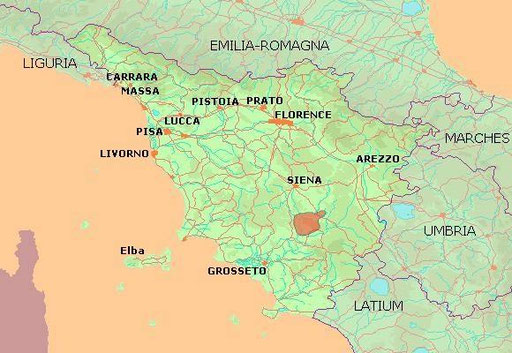
Map of the production area
GO TO CENTRAL ITALY REGIONAL WINES

OR MOVE TO THE OTHER MACRO-AREAS



SEARCH THE SITE
