 RuvidaMente







































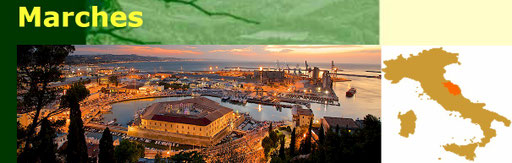
Verdicchio is the plenipotentiary of the wines of this pleasant Adriatic region, whose long-time devotion to whites no longer obscures the increasing merits of
its reds. The Castelli di Jesi DOC zone, covering a vast tract of hills west of the port of Ancona, is the home of the Verdicchio that made an early impression abroad in its
green amphora bottles. But recently producers have created a new image of Verdicchio as a white wine of special character that comes across even more convincingly in standard
bottles.
Class has risen so steadily that even wine still sold in the hourglass-shaped amphora seems a cut above the general level of popular whites. Verdicchio dei Castelli
di Jesi Classico, has been described as Italy's premier wine to serve with fish. Some producers make wines that develop such impressive depth and complexity with age that Verdicchio is
increasingly ranked among the noblest native white varieties of Italy.
In the region of Marches, Verdicchio di Matelica, is grown in limited quantities in a mountainous zone, which can have more body and strength than wines from
Jesi. Verdicchio from both DOC zones makes convincing sparkling wine as well, usually by the sealed tank method of fermentation, but also occasionally by the classical method in
bottle.
The recent Esino DOC, which coincides with parts of the two Verdicchio zones, provides for red and white wines, usually fresh and fruity. The region's other
white wines, notably Bianchello del Metauro and Falerio dei Colli Ascolani, are usually light and zesty and also go nicely with seafood.
The red wines of the Marches are based chiefly on Sangiovese and Montepulciano, sometimes blended, sometimes not. The most important in terms of
volume is Rosso Piceno, dominated by Sangiovese. It comes from a DOC zone covering much of the eastern flank of the region, stretching from the superiore area between Ascoli
Piceno and the sea north through the coastal hills to Senigallia.
Rosso Conero, dominated by Montepulciano, has gained even more praise, thanks to the devotion to quality shown by its leading producers. It originates
in a zone on the slopes of the Conero massif south of Ancona. Both Rosso Conero and Rosso Piceno were habitually made to drink within two to four years, when they are
persuasively round and fresh in flavor, though certain producers have made wines that age remarkably well from good vintages, sometimes for a decade or more.
The northern part of the region is the DOC zone of Colli Pesaresi, where the prominent wine is a Sangiovese, which bears a strong family resemblance
to the wines of that variety of neighboring Romagna. Although the emphasis remains strongly on native vines, recent results with such outside varieties as Cabernet Sauvignon, Merlot,
Chardonnay and Sauvignon have shown eminent promise in the temperate hills of the Marches.


GO TO CENTRAL ITALY REGIONAL WINES

OR MOVE TO THE OTHER MACRO-AREAS






SEARCH THE SITE
