 RuvidaMente













































CESANESE DI AFFILE
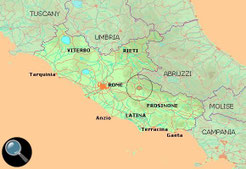
The vines that yield this appealing red wine, which was being praised as long ago as the 17th century, are situated in the
communes of Affile and Roiate in the hinterland of the province of Rome and on the verdant uplands of Arcinazzo at about 600 meters above sea level.
The Cesanese di Affile is produced almost entirely from the variety of the same name, a local clone of Cesanese Comune that is also admitted to the
wine’s grape mixture. In keeping with local tradition, the production discipline permits the use of a small percentage of white grapes, principally for the purposes of boosting the wine’s level
of acidity and enhancing its odors.
In the still flourishing tradition of the Roman inn, the Cesanese di Affile, along with that of Olevano and of Piglio, enjoys its peak moment at the beginning of each year when it is awaited with great expectation and received with enormous appreciation by a clientele that prefers it sweet, or at least sweetish, in combination with the most classic dishes of the popular cooking.
CESANESE DEL PIGLIO
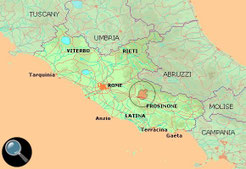
The only Denominazione di Origine Controllata wine of the province of Frosinone, the Cesanese del Piglio is produced in the communal territories of
Piglio, Serrone, Acuto, Anagni and Paliano. And it is one of the triad of DOC wines of Latium derived from the Cesanese variety, for which this particular part of Italy represents an
ideal habitat.
The Cesanese del Piglio is made almost entirely of grapes of the Cesanese di Affile, a local clone of Cesanese Comune, which can also be used
in the grape mixture. In comformity with local tradition, the production discipline permits the use of a small percentage of white grapes, principally for the purposes of boosting the wine’s
level of acidity and enhancing its odors.
While the Secco or dry version of the wine is excellent because of its substance, elegance and capacity for aging, the Dolce or sweet and
Abboccato or sweetish versions are highly popular.
Always racked precociously - as early as the end of November - the Cesanese del Piglio can be considered the ancestor of the novelli or nouveaux wines, which it resembles in that it goes exceptionally well with chestnuts.
However, tradition in the countryside insists that it must be available when a hog is slaughtered and hams, lonze (cured fillet of pork), sausages and blood puddings are made.
CESANESE DI OLEVANO ROMANO
The Olevano Romano Cesanese is produced in the Arcinazzo uplands, which are slightly to the south of the Cesanese di Affile territory. The little
community of Olevano Romano, located at the center of the production zone, is not perhaps well known to many Italians but it has long been appreciated by a host of foreigners and by Germans in
particular. They discovered the town through the paintings of the Tirolean artist Koch. As a result of his work, Olevano Romano is considered an obligatory stop for all those who are interested
in the fine arts.
A forest of ancient oaks that surrounds the town and that is known as La Serpentara is owned by the Prussian Academy of Fine Arts of Berlin and the hill of Baldi with
its old hamlet is the property of the Academy of Fine Arts of Bonn.
The Cesanese di Olevano is obtained almost entirely from Cesanese di Affile, a local clone of Cesanese Comune that can also be used in the grape
mixture. In keeping with the area’s tradition, the production discipline permits the use of a small percentage of white grapes, principally for the purposes of boosting the wine’s level of
acidity and enhancing its odors.
The Cesanese di Olevano is obtained almost entirely from Cesanese di Affile, a local clone of Cesanese Comune that can also be used in the grape mixture. In keeping with the area’s tradition, the production discipline permits the use of a small percentage of white grapes, principally for the purposes of boosting the wine’s level of acidity and enhancing its odors.

GO TO CENTRAL ITALY REGIONAL WINES

OR MOVE TO THE OTHER MACRO-AREAS





SEARCH THE SITE
