 RuvidaMente















































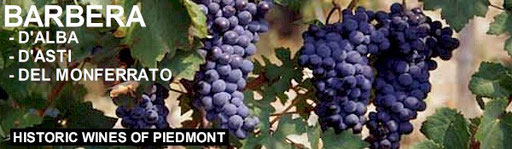
The Barbera variety's origins are extremely ancient but the first documents in which it is cited date to only several centuries ago. In fact, the first formal
citation of Barbera appears in a document of the 17th century that is now preserved in the city hall of Nizza Monferrato. And it was first officially mentioned in 1798 when Count
Nuvolone, deputy director of the agrarian society of Turin, drew up the first ampelography of the varieties cultivated in the vineyards of Piedmont.
"Il" or "la" Barbera, as it was traditionally called by Piedmontese farmers, whose brusk and unassuming character is precisely the same as
that of this frank and robust red, is one of the wines best known and appreciated throughout Italy for its generosity and strength. A. Strucchi, a noted Italian enologist, observed at the end of
the last century, that "when Barbera wine has attained five or six years of age, it is as suitable for consumption with roasted meats as Barolo and is often preferred by many to the more
famous wine.''
Famous for its capacity to create warmth and engender vigor, Barbera was hailed by the officers of the Savoyard army as a "sincere companion." For they said
that it encouraged a level-headed attitude at the most difficult moments in a hard-fought battle.
Praised by such outstanding poets as Carducci and Pascoli, Barbera is still recognized as an exceptional wine by many experts of the modern day.
Barbera was described in 1798 by Count Nuvolone in the first ampelography of the grape varieties cultivated in Piedmontese vineyards under the name "Vitis vinifera
Montisferratensis." That denomination was due to the historical name of a hilly region that is, still today, the principal center for the cultivation of the Barbera variety: the
Monferrato.
It is quite probable that Barbera was created by the spontaneous crossing of even older varieties. What is certain is that the origins of the Barbera
variety are extremely ancient, even if the documents in which it is first mentioned go back to only a few centuries ago. In fact, the first formal citation of Barbera is contained in a
document of the 17th century now preserved in the Nizza Monferrato city hall.
In chronological order, the first allusion to and praise for Barbera have been traced to Paul the Deacon. According to his account of the Battle of Refrancore
in 663, the Longobard troops of Grimaldo defeated the Franks after getting them drunk on wine from neighboring cellars. He reported that the Longobards filled a large number of amphoras with the
wine and scattered the containers over the surrounding fields. The jugs caught the Franks' attention and they avidly quaffed the contents.
The origins of this variety are extremely ancient but the first documents in which it is cited date to only several centuries ago. In fact, the first formal citation of
Barbera appears in a document of the 17th century that is now preserved in the city hall of Nizza Monferrato. And it was first officially mentioned in 1798 when Count Nuvolone, deputy
director of the agrarian society of Turin, drew up the first ampelography of the varieties cultivated in the vineyards of Piedmont.
The first poet to hymn its praises was Giosue' Carducci, who spoke of "generous Barbera,'' which makes all who drink it feel envigorated. More recently, Cesare
Pavese, in one of his letters, described the wine as "legendary.'' And numerous modern experts fully recognize Barbera's many virtues.
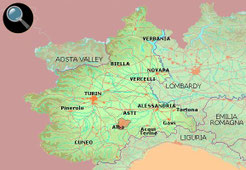
BARBERA D'ALBA
Production area: in the hilly area around Alba in the province of Cuneo. Only vineyards in the hills with suitable slopes and orientations are considered adapted to production. And the
terrains must be primarily clayey-calcareous or sandy-calcareous in character.
DOC recognition is excluded for terrains with northern exposures and the bottoms of valleys that are flat or semi-flat.
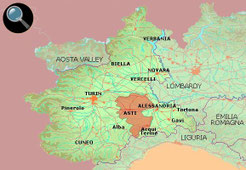
BARBERA D'ASTI
Production area: 118 communes in the province of Asti and 50 in the province of Alessandria.
Only vineyards in the hills with suitable slopes and orientations are considered adapted to production. And the terrains must be primarily clayey-calcareous or sandy-calcareous in character.
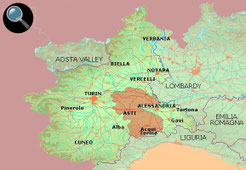
BARBERA DEL MONFERRATO
Production area: Upper and Lower Monferrato, in the province of Alessandria and part of the province of Asti. Only vineyards in the hills with suitable slopes and orientations are considered adapted to production. And the terrains must be primarily clayey-calcareous or sandy-calcareous in character. DOC recognition is denied for terrains in valley bottoms or plains areas and for those that are too damp or insufficiently sunny.
Today, Barbera wine represents about 50% of the whole vinicultural output of Piedmont. It is, in fact, Piedmont's wine par excellence to such a point that its image is identified with that of the region as a wine producer.
GO TO NORTHWEST REGIONAL WINES

OR MOVE TO THE OTHER MACRO-AREAS




SEARCH THE SITE
