 RuvidaMente








































According to some experts the Dolcetto grape originated in France but it is more probable that the variety first appeared in the Monferrato around the year
1000 and that its systematic cultivation began in the late Middle Ages. The variety quickly spread throughout the Monferrato and into the western part of Liguria, the Oltrepò Pavese and parts of
the areas around Milan and Piacenza
Aside from a citation in a document of the 16th century, the first certain reference to the Dolcetto variety appears in the Istruzione, written at the end of
the 18th century by Count Nuvolone, deputy director of the Turin Agrarian Society. The volume, in fact, contains some information about a grape and a wine known as “Dosset’’ and about
the zone in which it was produced.
Some experts argue that Dolcetto originated in France. But there is greater support for the theory that Dolcetto appeared in the Monferrato around the year 1000.
The variety was soon being grown throughout the entire Monferrato as well as in the western part of Liguria, the Oltrepò Pavese and parts of the districts around Milan
and Piacenza.
Those unfamiliar with the wine are often misled by the name and assume that Dolcetto is a sweet beverage. The fact is that the wine with the misleading name is
quite dry and has a slightly bitterish flavor. However the grape that yields the wine is quite sweet, so much so that in the past it was much appreciated as a fine table grape. But that sweetness
is not passed along to the wine.
As a wine, Dolcetto is much appreciated by small producers, even if some of the big and well-known wine houses do not hesitate to produce it, since it seems to
be catching on with a steadily growing number of consumers.
Seven wines made from Dolcetto grapes have received their Denominazione di Origine Controllata recognition. Four types of Dolcetto had been
distinguished as long ago as 1924 and the number has since risen to seven.
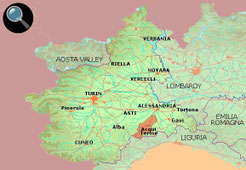
DOLCETTO D'ACQUI
The territory, occupied by a total of 23 communes, consists of a small stretch of hills of the province of Alessandria in the southernmost part of Piedmont, virtually
on the border with the region of Liguria.
Dolcetto d’Acqui is produced in the Upper Monferrato, a winemaking district that is centered, for the most part, on Acqui Terme and Ovada.
As a wine, Dolcetto is much appreciated by small producers, even if some of the big and well-known wine houses do not hesitate to produce it, since it seems to be catching on with a
steadily growing number of consumers.
Production zone: 23 communes in the province of Alessandria. Only hilly vineyards with appropriate slopes and exposures and terrains of a clayey-tufaceous-calcareous
nature are considered adapted to production.
Production zone:
23 communes in the province of Alessandria.
Only hilly vineyards with appropriate slopes and exposures and terrains of a clayey-tufaceous-calcareous nature are considered adapted to production.
DOLCETTO D'ALBA
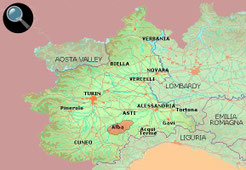
Many superb products of the Alba region, ranging from white truffles to meats and sheep’s-milk cheese, are known and appreciated throughout Italy. However, the most
famous of all are the district’s wines, such as Barolo, Barbaresco, Moscato, Barbera, Nebbiolo and Dolcetto.
The latter wine, Dolcetto d’Alba, has made a particularly decisive contribution to the reputation of that community. However, Alba has a long and fascinating history, first under the
Romans with the name Pompeia, then in the Middle Ages when it was a rich and flourishing commune and, finally, as an important agriculture center in the fertile and attractive territory of the
Langhe.
Some decades ago, centers of distribution were established in the district and the grape was soon being shipped as far away as Belgium. Today, the grapes produced by
the Dolcetto variety are used only for the production of a special wine with characteristics that vary according to the zone in which the vine is cultivated.
Among the various types of Dolcetto, the most representative is clearly that produced in the Alba district. With the passage of time, in fact, the Dolcetto
d’Alba has steadily widened its circle of admirers because of its attractive purplish ruby-red color, its characteristic odor and that aftertaste of bitter almonds that is one of its most
prominent features.
In that regard, it is said that Dolcetto d’Alba "baroleggia", which means that its darker color and greater alcohol enable it to develop premium
qualities through aging of a period of two or three years. During that period, special qualities evolve that make the wine comparable to Barolo and Gattinara. Some even prefer
it because it is lighter and more subtle than the two other wines.
Production zone:
the hills of the Alba area, including the territory of 25 communes, in the province of Cuneo and the commune of Coazzolo in the province of Asti. Only hilly vineyards with appropriate slopes and exposures and terrains that are clayey-calcareous or calcareous-sandy in nature are considered suitable. The DOC is not extended to vineyards situated in valley bottoms.
DOLCETTO D'ASTI
Dolcetto d’Asti is made in the Monferrato, which is without doubt the area in Piedmont where winemaking is most extensively pursued. Within the Monferrato, the
production zone, which is bordered by the so-called Langhe Albesi, consists of the territory of 24 communes. In that strip of land, the growers find that Dolcetto is a viable alternative
to the cultivation of Barbera.
It makes a young wine that is easy to drink and that is adapted to consumption with dishes of moderate structures. It is made only from Dolcetto grapes and, despite its name, it has a dry and bitterish flavor.
Production zone:
the hills around Asti in the province of Asti. Only hilly vineyards with appropriate slopes and exposures whose terrains are primarily clayey-calcareous or calcareous-sandy in nature are considerable suitable.
Vineyards situated in valley bottoms have no right to the DOC.
DOLCETTO DELLE LANGHE MONREGALESI
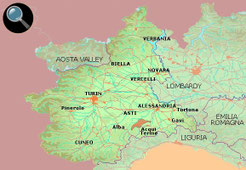
The Langhe is one of the most outstanding of Piedmont’s wine-producing areas. It extends along the right bank of the Tanaro river, forming a sort of peninsula in which
are located all the vinicultural communes of the province of Cuneo. It is there, in the hilly districts of Mondovì, Briaglia, Castellino and Tanaro in the Langhe Monregalesi that one of the many
Dolcettos of Piedmont is produced.
The wine is made from the grape of the same name. The variety is quite sensitive to geological variations of the terrains in which it is planted and the wine takes on
shadings that differ according to the nature of the soil, even when vineyards are located only a few miles apart. It adapts well to higher elevations so that it is often found at altitudes of as
much as 600 meters in the Upper Monferrato.
Modestly and discreetly, without much publicity, Dolcetto has managed to establish a good image as a wine that can be drunk throughout a meal. It is also
appreciated as a lively and fragrant wine with outstanding characteristics.
It received the Denominazione di Origine Controllata in 1974 and now, more than then, the future appears quite promising for this highly regarded Piedmontese
product.
Production zone:
the hills surrounding the river Tanaro in the province of Cuneo and, more precisely, the entire territories of the communes of Briaglia, Castellino, Tanaro, Igliano, Marsaglia and Niella Tanaro and parts of those of Carrù, Mondovì, Murazzano, Piozzo, San Michele Mondovì and Vicoforte.
Only hilly vineyards with appropriate slopes and expositions whose terrains are primarily clayey-calcareous or calcareous-sandy in nature are considered adapted to production. Those in valley bottoms are excluded.
DOLCETTO DI DIANO D'ALBA
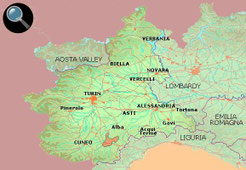
The Dolcetto di Diano d’Alba production area is practically surrounded by hills on which grapes for Dolcetto d’Alba are grown. The general production
zone is known as the Langa Albese district of Piedmont.
The area, resembling a peninsula and lying between the Belbo and Tanaro rivers, is famous as the home of Barolo and Barbaresco.
The wine made from Dolcetto grapes represents a worthy addition to that illustrious list.
Dolcetto di Diano d’Alba is a young and well-balanced wine that is fruity and richly structured. It goes extremely well with a wide variety of foods, which
assures brisk demand on the world’s major markets.
Production zone:
the hilly zone of the communal territory of Diano d’Alba in the province of Cuneo.
Only hilly vineyards with appropriate slopes and exposures are considered suitable for production.
Flatlands and bottoms of valleys are excluded.

DOLCETTO DI DOGLIANI
Dogliani in the province of Cuneo is well known for its winemaking tradition and it can claim an ancient foundation for it.
The community’s most illustrious citizen was Luigi Einaudi, the first president of the Republic of Italy. A good Piedmontese, he still found time, despite his official duties, to keep his fingers
on the pulse of his wine estate, situated in the vicinity of Dogliani.
The town’s name is derived from Doglia and Lano, which is a corruption of Janus or Giano, the Roman god par excellence, who was lord
of the sky and of sunlight. Janus later assumed special powers as protector of the beginning and end of all things. According to legend, Janus visited the Langhe and stopped off at
Dogliani, detained by the excellence of the local wine.
Dolcetto di Dogliani has long appeared on the tables of mere mortals, including some of the most illustrious of them. In 1369, the Marquesses of Saluzzo
granted the citizens of Dogliani the right to dispose of their goods and exemption from taxes as well as from the obligation of military service.
However, they imposed a tax “in wine’’ to assure that their noble cellars would be supplied with good Dolcetto. Dolcetto di Dogliani was specifically mentioned for the first time in 1593 in a declaration titled "Orders for the Harvest." That document provides official confirmation that Dolcetto grapes were being grown at Dogliani even before the end of the 16th century.
Production zone:
the restricted hilly district of the province of Cuneo based on Dogliani. More precisely, it includes the entire communal territories of Bastia, Belvedere, Langhe, Clavesana, Cigliè, Dogliani, Farigliano, Monchiero and Rocca di Cigliè and parts of those of Roddino and Somano. Only hilly vineyards with appropriate slopes and exposures whose terrains are prevalently clayey-calcareous or calcareous-sandy in nature are considered suitable. Vineyards in valley bottoms are excluded from the DOC.
DOLCETTO DI OVADA
Dolcetto di Ovada was recognized as a Denominazione di Origine Controllata wine in 1972.
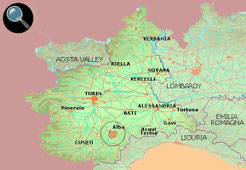
The production zone of Dolcetto di Ovada, which extends along the course of the river Orba, is a grape-growing district situated in the southern part of the province of Alessandria.
The prevalently hilly district includes 22 communities with Ovada at the center. In the past, the river Orba was considered the extreme eastern limit of the cultivation of Dolcetto grapes.
Production zone:
Ovada and various other neighboring communes in the province of Alessandria.
Only hilly vineyards with appropriate slopes and exposures whose terrains are prevalently clayey-tufaceous-calcareous in nature are considered suitable for production.
GO TO NORTHWEST REGIONAL WINES

OR MOVE TO THE OTHER MACRO-AREAS




SEARCH THE SITE
