 RuvidaMente


















































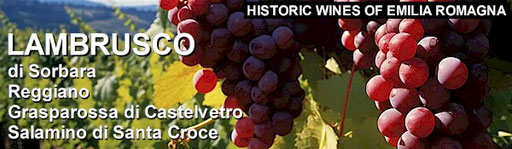
In the provinces of Reggio Emilia and Modena, Lambrusco vineyards extend from the slopes of the hills to the line of the Po river, which separates the district
from Mantuan territory.
All four of the existing Lambrusco Denominazioni di Origine Controllata are found in that zone.
Although it is of extremely ancient origin, Lambrusco was never well known or appreciated outside its production area until it achieved a remarkable commercial success
in the United States in the seventies and eighties.
Despite the fact that it is now widely distributed, there are still many prejudices about the wine. Matters are not made easier by the widespread conviction that there
is only one Lambrusco when, in reality, there are many, each different from the other in sensory characteristics and composition, whether in terms of the subvariety used or in those of
area of origin.
Lambrusco has an extremely noble background. The wild vine from which the existing variety originated, called labrusca by the Latins, was known to the
Etruscans and Romans. And its fossilized remains have been found in soils of the Eocene period.
The Romans made a bitterish beverage from labrusca grapes, which Pliny the Elder recommended for its supposed therapeutic effects. The elder Cato cited the
productiveness of the Emilian vines, which he described as “tricentennary” because a single jugerum (about half an acre) yielded 300 amphoras of wine.
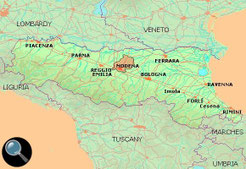
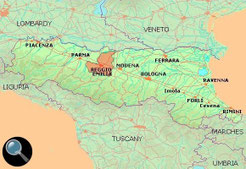
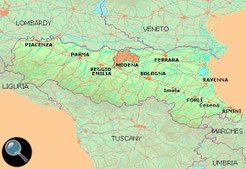
Maps of the production area
LAMBRUSCO DI SORBARA
LAMBRUSCO GRASPAROSSA
DI CASTELVETRO

LAMBRUSCO REGGIANO
LAMBRUSCO SALAMINO
DI SANTA CROCE
GO TO NORTHWEST REGIONAL WINES

OR MOVE TO THE OTHER MACRO-AREAS





SEARCH THE SITE
