 RuvidaMente

















































Cortese is one of the most important dry white wines produced in Piedmont. It does not enjoy the same reputation as the reds and Moscatos, which take pride of
place in the region, but it is, in any case, an excellent wine for consumption at meals.
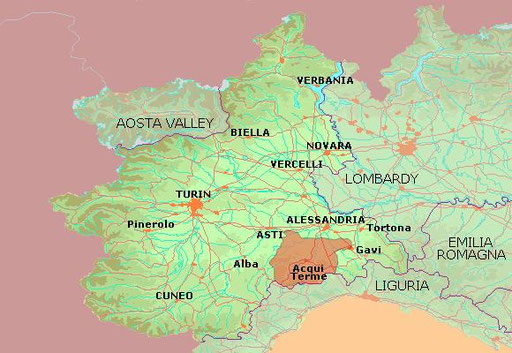
It is produced in the Upper Monferrato in a district bounded by the rivers Bormida and Scrivia and flanked by the Ligurian Apennines. The winemaking area’s principal
centers are Acqui, Ovada and Novi, all in the province of Alessandria.
Cortese, which is the district’s most typical white-grape variety, is believed to have originated locally and was already well known by the 18th
century.
The first fairly detailed description of the Cortese grape can, in fact, be found in the ampelography of the varieties cultivated in Piedmont that was compiled
by Count Nuvolone, deputy director of the Turin Agrarian Society, in 1789. He observed that Cortese “has rather elongated clusters with fairly large grapes, which, when ripe, become
yellow and good to eat. The vine bears abundantly and the wine keeps well.’’
That first description was followed by another written in 1852. That account described production in various parts of the region, including “old Piedmont,’’
and emphasized that the grape was appreciated because of its purity as well as its vigorous output.
In addition, because of the variety’s considerable resistance to diseases and to unfavorable climatic conditions, it was considered highly suited to the western Oltrepò
Pavese, where it was frequently included in new plantings.
The Cortese dell’Alto Monferrato received its Denominazione di Origine Controllata in 1979 and has made a major contribution in recent years to the expansion
of the production of Piedmontese white wines, which, still today, represent only slightly more than a third of the output of reds.
Map of the production area
GO TO NORTHWEST REGIONAL WINES

OR MOVE TO THE OTHER MACRO-AREAS







SEARCH THE SITE
