 RuvidaMente





























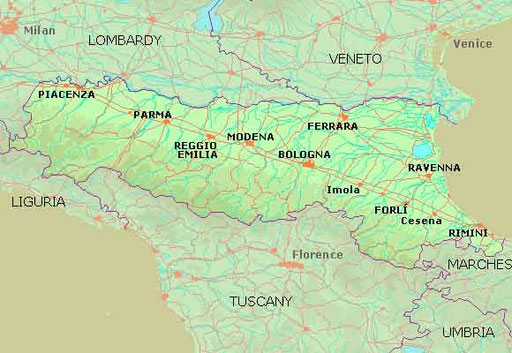
As Italy's capital of gastronomy, Bologna was known as la grassa (the fat), a description less flattering today than it once was. But the city still gloats over a land
of plenty that extends along the fertile southern flank of the Po. Emilia (to the west of Bologna) and Romagna (to the east) flaunt their considerable differences, but together share Italy's most
luxuriant tables.
Recipes, like the names of dishes, vary from town to town in a region that breeds culinary heroes: Ferrara's Christoforo di Messisbugo, who chronicled the lavish menus
of Renaissance courts; Parma's Duchess Marie Louise (wife of Napoleon), whose tastes inspired generations of dishes; Modena's Este dukes, who fostered the cult of aceto balsamico, the monarch of vinegars; Forlimpopoli's Pellegrino Artusi, the author known as the father of modern Italian
cooking.
In Emilia-Romagna the honor roll of foods is led by pasta, made with fresh eggs and rolled by hand by a sfoglina to achieve perfect texture. The universal
primo is tagliatelle con ragù, though cooks consider the meat sauce personal works of art. Bologna, whose specialties include green lasagne and curly gramigna, disputes
with Modena the creation of tortellini (modeled after Venus's navel).
Parma's prides are large square envelopes called tortelli and the rounded anolini, which are also made in Piacenza, home of the bean-shaped pisarei. Ferrara's cappellacci (big hats) are stuffed with squash. Reggio's cappelletti (little hats) differ from pasta of the same name in Romagna, whose specialties include the rolled tubes called garganelli and slim dumplings called passatelli. Pasticcio is pasta with other ingredients baked in a pie, though interpretations vary.
Polenta, once a staple of the country diet, now plays a secondary role to pasta in the region, as do rice and gnocchi. Vegetables, greens and legumes
of all sorts are grown here, though they are often cooked in soups or with pasta. Romagna has a native species of shallot protected as IGP Scalogno di Romagna. Mushrooms from the Apennines are prized, notably from around Borgotaro, where they enjoy IGP status. Romagna produces a bit of olive oil, protected
under DOP for the town of Brisighella.
Baked nearly everywhere are hard wheat rolls of snow white interior and tawny crust called coppiette, due to their shape resembling a "coupled" set of horns.
Local versions of flatbreads abound. Most renowned is Romagna's circular piadina or piada, baked on tiles (or griddles) and folded over prosciutto, cheese or greens. Thicker
focaccia is called spianata or torta salata, though with salt pork in the dough it becomes crescentina at Bologna. In Emilia's hills, paper thin
borlengo or burleng is cooked like a crêpe, dressed with salt pork, garlic and rosemary, folded into quarters and served with grated Parmigiano. Similar flavorings are used on
the muffin-like tigelle, baked between tile disks.
Crisp fritters are made through Emilia, originally fried in lard but now more often in oil, sometimes flavored with pork crackling, prosciutto or sausage, though types
vary. Examples are burtleina at Piacenza, torta fritta at Parma, gnocco fritto at Modena, chizza at Reggio. Bologna's renowned fritto misto combines
pastry fritters with fried meats and vegetables. The filling of fried cassoni includes spinach and raisins.
In Emilia, the curing of pork is an age-old master craft. Prosciutto di Parma, Italy's best known meat
product, is protected by DOP, as is the rare but even more prized Culatello di Zibello, a filet of rump aged in the foggy
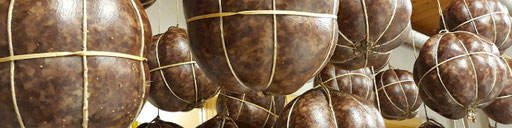
lowlands along the Po. Bologna is noted for giant loaves called Mortadella, though the IGP extends through the region
and beyond. Modena pig's foot sausage zampone is eaten nationwide at the New Year with lentils for luck. DOP protects Zampone di
Modena and Prosciutto di Modena, while IGP applies to Cotechino
di Modena, a sausage whose stuffing includes bits of rind.
Piacenza is a center of salume production, with DOP applied to Coppa Piacentina, the neck roll,
elsewhere called capocollo, as well as Salame Piacentino and the un-smoked bacon known as Pancetta Piacentina. Ferrara's salama da sugo blends choice bits of pork in a juicy stuffing with red wine, cinnamon, cloves and nutmeg. Emilians all make lean
and mildly seasoned salame gentile.
The Romagnola breed of cattle is covered by the IGP of Vitellone Bianco dell'Appennino
Centrale. Other meats appreciated throughout the region are veal, turkey, capon, chicken and rabbit. Romagnans have a taste for duck and grilled and roast pork, lamb and mutton.
Cesenatico is the seafood haven of Romagna, whose brodetto is among the tastiest of the Adriatic's fish soups. Eels from the Comacchio lagoon may be stewed, roasted or grilled.
Emilia's Parmigiano Reggiano, the "king of cheeses," is firm yet brittle enough to break into
bite-sized chunks of elegantly mellow flavor. Aging makes Parmigiano golden and hard for grating. Romagna's formaggio di fossa from the milk of sheep or cows is ripened in caves for
three months. Ravaggiolo and squaquarone are tangy cream cheeses used mainly in cooking.
Sweets seem almost sinful after such rich fare. That may explain why fruit, especially home grown peaches, cherries, strawberries, pears and muskmelons, as well as
nuts, are prominent in the diet. Of special note are the cherries of Vignola and the pears, peaches and nectarines protected as IGP in Romagna. Chestnuts thrive in the Apennines, where the
Marrone del Castel Rio rates an IGP.
Emilia-Romagna boasts its share of biscuits, pastries, tarts, sweet ravioli and tortelli, sherbets and ices. Traditional desserts include Bologna's certosino
(spice cake), Ferrara's torta di mele (apple cake), Modena's bensone (lemon-flavored crumble), Romagna's gialetti (cornmeal biscuits) and piada dei morti
(flatbread with nuts and raisins).
Aceto balsamico tradizionale is aged at least 12 years in barrels of different types of wood to
become dark, dense and almost too divine to be called vinegar. The traditional type is protected by a DOP in Modena and Reggio, but imitations abound. The tradizionale is a unique condiment for
meat, fish, and vegetables or the prime ingredient in sauces. Vinegars of 20 years old or more may be sipped from a teaspoon as a cordial or digestive.
REGIONAL SPECIALITEIS:
OLIVE OILS
• BRISIGHELLA • COLLINE DI ROMAGNA
•
VINEGARS
• ACETO BALSAMICO TRADIZIONALE DI MODENA •
• ACETO BALSAMICO TRADIZIONALE DI REGGIO EMILIA •
FRESH & CURED MEATS
• COPPA PIACENTINA • COTECHINO DI MODENA •
• CULATELLO DI ZIBELLO • MORTADELLA BOLOGNA •
• PANCETTA PIACENTINA • PROSCIUTTO DI MODENA •
• PROSCIUTTO DI PARMA • SALAME PIACENTINO •
• SALAMINI ITALIANI ALLA CACCIATORA •
• VITELLONE BIANCO DELL'APPENNINO CENTRALE •
• ZAMPONE DI MODENA •
CHEESES
• GRANA PADANO • PARMIGIANO REGGIANO •
FRUITS
• MARRONE DI CASTEL DEL RIO • PERA DELL'EMILIA-ROMAGNA
•
• PESCA E NETTARINA DI ROMAGNA •
VEGETABLES
• ASPARAGO VERDE DI ALTEDO • FUNGO DI BORGOTARO •
BREADS & CEREALS
• COPPIA FERRARESE IGP •
GO TO MORE NORTH REGIONAL FOODS

• AOSTA VALLEY • PIEDMONT • LIGURIA • LOMBARDY • VENETO •
• TRENTINO ALTO ADIGE • FRIULI VENEZIA GIULIA • EMILIA ROMAGNA •
Follow the links below to get an
overview of the other main macro-areas of Italian food.


Or quickly discover Italian foods by type




SEARCH THE SITE
