 RuvidaMente



























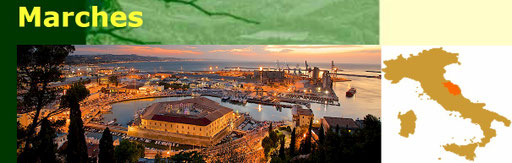
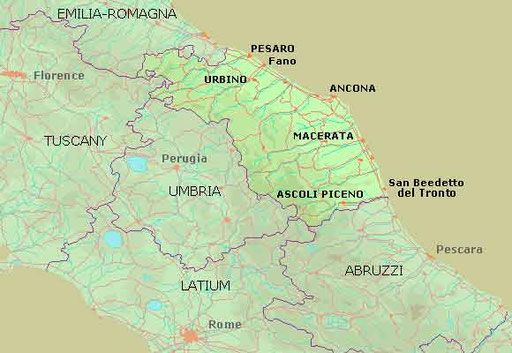
In this gently hilly region between the Adriatic and the Apennines, cooks draw from sea and land and with enviable ease bring the best of both to the table. Fish prevails in the port of Ancona, whose brodetto calls for exactly 13 types in a spicy broth with garlic and tomato. The Adriatic provides the freshest of seafood, sardines, hake, bream, sole, red mullet, crustaceans and mollusks, but Ancona is also famous for a dish based on dried cod called stoccafisso or stocco all'anconetana.
The Marches fits central Italian stereotypes with its fine olive oil and pecorino, as well as unsalted bread. But it also feels the culinary influence of Emilia-Romagna with its fresh egg pasta and salumi. At Urbino, they vary Romagna's cheese-based passatelli by adding meat to the mixture. Macerata is the home of vincisgrassi, a legendary lasagne crowned, in season, with white truffles, which flourish in the Marches as nowhere else outside of Piedmont.
Marches menus cover a thorough mix of meats: quail, pigeon, guinea fowl, chicken, rabbit, lamb, pork, beef and veal (including the Marchigiana breed of cattle, which is covered under the IGP of Vitellone Bianco dell'Appennino Centrale).
It's curious to note that meat and seafood may be cooked in similar ways. For example, poultry, fresh fish or even dried cod are often done in potacchio (with onion, tomato, white wine and rosemary), while duck, rabbit, ham or even sea snails may be done in porchetta (with wild fennel, garlic and rosemary).
The region that stakes persuasive claims to the origins of porchetta, also makes an impressive range of salumi. Notable are the prosciutto from the town of Carpegna, which rates a DOP, the salame of Fabriano and the cotechino of San Leo. Around Macerata they make a sort of sausage called ciauscolo, soft enough to spread on bread like paté.
At Ascoli Piceno, giant olives are stuffed with a meat-cheese-bread filling and deep fried. Zucchine and peas are favored in season, while beans and chickpeas are used year-round for soups. Greens include ròscani, whose spinach like leaves have an acidic bite. Lentils grown in the Apennines to the south of the Marches qualify under the DOP of Lenticchie di Castelluccio di Norcia, centered in Umbria.
Pecorino is preferred young and mild, sometimes almost sweet. Casciotta d'Urbino, a DOP made from a blend of sheep and cow's milk, has been known since the Middle Ages. The rare ambra cheese from the town of Talamello is also made from a mix of sheep and cow's milk into forms wrapped in cloth and buried in pits carved out of tufa where mold forms and accounts for special flavor.
Cheese often figures in focaccia and pizza, as well as in desserts, which are usually moderately sweet. Ravioli-like pastries are Ascoli's calcioni (made with fresh pecorino) and Macerata's piconi (with ricotta, rum and cinnamon). Corn flour is used in Ancona's beccute (biscuits with raisins and nuts) and frustenga (cake with figs, raisins and walnuts).
Regional SpecialitIes:
FRESH & CURED MEATS
• Prosciutto di CarpegnA • Mortadella Bologna •
• Vitellone Bianco dell'Appennino Centrale •
• CIAUSCOLO •
CHEESES
VEGETABLES
GO TO MORE NORTH REGIONAL FOODS

Follow the links below to get an
overview of the other main macro-areas of Italian food.


Or quickly discover Italian foods by type




SEARCH THE SITE
