 RuvidaMente

























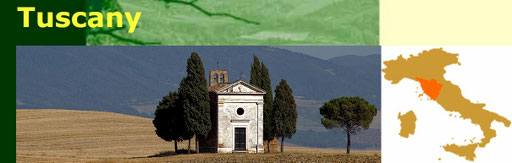
Florentines like to relate how their Caterina de' Medici, on marrying King Henry II in 1533, introduced the recipes and cooks that ennobled French cuisine. It's true
that in Renaissance Florence gastronomy reached heights of refinement among the aristocracy, yet what has distinguished Tuscan food since the time of the Etruscans has been its noble
simplicity.
Country cooking attests to the seasonal goodness of garden produce and the perennial splendor of green-gold extra virgin olive oil. Tuscans are fanatical about
freshness: fava beans, artichokes and asparagus in the spring; tomatoes, cucumbers and zucchini in the summer; all sorts of greens and mushrooms (especially plump porcini) in the fall; cabbages and chard in the winter. Herbs, above all rosemary and sage, are
good year-round, as are the fresh or dried white beans toscanelli, cannellini, zolfini that earned Tuscans the
epithet of mangiafagioli (bean eaters).
Bread is the pillar of the Tuscan diet, giant loaves of salt-free pane toscano redolent of sourdough and woodsmoke. Thick slices are grilled, rubbed with garlic and
doused with oil as fettunta or panunto. When firm, the bread is dampened and crumbled into a salad with tomatoes, onion and basil as panzanella or spread with chicken
liver paté or chopped tomatoes as crostini. It thickens soups called ribollita, pappa al pomodoro or simply zuppa di pane.
Farro, the ancient grain that is protected as IGP in the Garfagnana range of the Apennines, is also the base of a hearty soup. Chestnuts, especially the prized marrone type protected as IGP in the Mugello range of the Apennines, are eaten roasted or used in soups and desserts.

In Tuscany pasta had been historically upstaged by soups, whether or not they included bread. But pasta is by no means ignored. No country feast would be complete
without tagliatelle con ragù. Also invariably homemade are the wide-ribbon pappardelle, served with hare or duck sauce, and pici, rustic spaghetti. Rice and polenta also play
roles in the diet.
Seafood prevails along the coast, where Livorno's cacciucco is a piquant soup. Salt cod and tripe bring zest to the diet, though Tuscan cooking is rarely
highly spiced and never boringly bland. That's because food is intended to go with wine, above all the red Chianti, Brunello di Montalcino and Vino Nobile di Montepulciano that are known as vini da
arrosto.
The roast meats to flatter these wines might include rabbit, pigeon, duck, free-range chicken, thrush, pheasant and guinea hen. Pork is popular as grilled ribs
(rostinciana), roast loin (arista), spit-roasted livers wrapped in bay leaves (fegatelli) or as porchetta. It is also used for sausages, prosciutto and salame
known as finocchiona (flavored with wild fennel seeds). Wild boar, a source of salame, sausage and prosciutto, may be stewed with sweet-sour sauce.
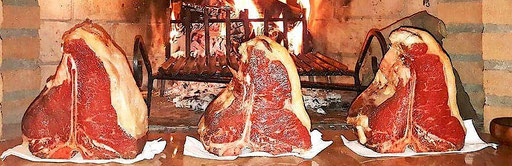
The glory of Tuscan meats is bistecca alla fiorentina, a hefty slab of Chianina beef, seared over wood coals so that the juicy red interior is enclosed in a
charred crust. Chianina beef is included in the IGP of Vitellone Bianco dell'Appennino Centrale.
Pecorino Toscano is most savory from sheep grazed on moors around the town of Pienza near Siena,
though it is also prominent from the Monte Amiata massif and in the province of Grosseto. Mild young, when it may be called marzolino, fresh pecorino is eaten in the spring with raw fava
beans. When aged in small wheels coated with olive oil, ash or tomato, it becomes firm with a distinctly elegant tang. A bit of Pecorino
Romano is produced in the province of Grosseto.
Bakers, beyond their daily loaves, also make flatbread called schiacciata, sometimes with rosemary or in a sweet version with grapes. Most Tuscan sweets are
baked. Almonds flavor Prato's crunchy biscottini or cantucci and the soft ricciarelli of Siena, a town more renowned for its chewy fruit and nut cake called panforte. Chestnuts
are the base of castagnaccio, a flat cake with pine nuts and rosemary, and crepes called necci. Anise flavors wafers called brigidini and a raisin cake called
buccellato. Fruit jams are used in tarts called crostate. Florence's pride is zuccotto, a dome-shaped sponge cake flavored with chocolate, nuts and liqueurs.
REGIONAL SPECIALITIES:
OLIVE OILS
• CHIANTI CLASSICO • TERRE
DI SIENA • TOSCANO •
FRESH & CURED MEATS
• MORTADELLA BOLOGNA IGP • PROSCIUTTO TOSCANO
•
• SALAMINI ITALIANI ALLA CACCIATORA •
• VITELLONE BIANCO DELL'APPENNINO CENTRALE •
CHEESES
• PECORINO ROMANO • PECORINO TOSCANO
•
FRUITS
• CASTAGNA DEL MONTE AMIATA •
• FARINA DI NECCIO DELLA GARFAGNANA •
VEGETABLES
• FAGIOLO DI SORANA • FUNGO DI BORGOTARO
•
BREADS & CEREALS
• FARRO DELLA GARFAGNANA •
SWEETS & CONFECTIONS
• CANTUCCINI • PANFORTE • RICCIARELLI •
GOURMET SPECIALITIES
GO TO MORE NORTH REGIONAL FOODS

Follow the links below to get an
overview of the other main macro-areas of Italian food.


Or quickly discover Italian foods by type




SEARCH THE SITE
